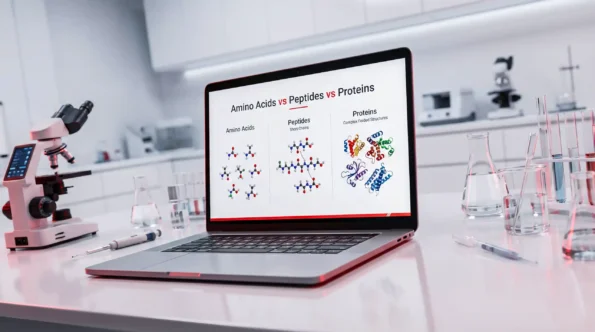
Peptides vs Proteins vs Amino Acids

Peptides, proteins, and amino acids are the important molecular components of cellular research based systems. They play critical roles in structural organization, signaling pathways, and enzymatic activity across experimental models. However, these three compounds are quite different from each other in terms of their molecular structure and properties. The primary difference between these compounds is […]

CONTINUE READING ➞

How Research Peptide Quality Impacts Experimental Outcomes?

Research peptides are short amino-acid chains used as research reagents in laboratory settings. Research peptide quality holds paramount importance in the analytical research sector. It may change the conclusions and reproducibility in preclinical models. Although multiple factors intervene in the peptide-related research outcomes. The most common among them is the impurity of research peptides. Studies have […]

CONTINUE READING ➞

USA-Based Research Peptide Supplier: Why Location Matters?

When it comes to sourcing research peptides, you need to make sure that you trust the right suppliers around. Some researchers prefer US-based suppliers due to familiarity with domestic chemical-handling and labeling frameworks. A high-quality peptide from a reputable supplier can help with peptide integrity, analytical accountability, and research reproducibility.  Read the full blog to […]

CONTINUE READING ➞

How Peptides Function at the Molecular Level?

At the molecular level, peptides function through their structure, chemical bonding, and interaction with other biological molecules. Peptides are short chains of amino acids that are linked together through peptide bonds, which form a defined sequence.  The peptide sequence helps determine how the molecule behaves in the cellular environment. In the following blog, we’ll give you a […]

CONTINUE READING ➞

How is Research Peptide Purity Determined?

The most common method for determining research peptide purity is reversed-phase high-performance liquid chromatography (RP-HPLC). It is coupled with mass spectrometry and a few additional analytical techniques.  The research peptide purity is determined by analytical laboratory techniques. These techniques are used to separate, identify, and measure peptide molecules from unwanted byproducts. Peptide purity helps with […]

CONTINUE READING ➞
Close My Cart
Close Wishlist
Recently Viewed Close
Close

Close
Navigation
Categories
Newsletter

Newsletter

Be the first to know about our new arrivals, exclusive offers and the latest Compounds update.